What Would Happen If the U.S. Used a Nuclear Weapon in the Middle East?
6 Nov 2026 · @theamericanreveal
If a U.S. president ordered a nuclear strike in the Middle East, the damage would not stay at the target. It would mean mass casualties, fallout drifting across borders and attacks on U.S. troops. It would also mean an oil shock and the end of a taboo that has held since 1945.
To be clear, this is a hypothetical. No country has used a nuclear weapon in war since the U.S. bombed Nagasaki on August 9, 1945. On April 23, 2026, President Trump said "a nuclear weapon should never be allowed to be used by anybody" (Arms Control Association). He ruled out a nuclear strike on Iran again in an October 15 interview (Al Jazeera).
The question still matters because the U.S. is at war with Iran. U.S. strikes on Iran began on February 28, 2026 (Arms Control Association). In April, Trump's warning that "a whole civilisation will die tonight" was widely read as a nuclear threat (Al Jazeera). In early November, U.S. forces struck Iran's Qeshm Island while Qatari mediators pushed for a deal (Just Security).
Here is what research and recent events suggest would follow a nuclear strike, step by step.
Who can order a U.S. nuclear strike?
Only the president. As commander in chief, the president has sole authority to order nuclear use, and neither Congress nor the military has to approve it (Congressional Research Service).
The process is built for speed:
The president consults advisers, including the chairman of the Joint Chiefs and the head of U.S. Strategic Command, who lays out the options.
The president picks a prepared war plan, or asks for a new one if there is time.
The president confirms his identity with codes from a card called the "biscuit" and sends the order through the "nuclear football."
Strategic Command carries it out. Land-based missiles can fire about two minutes after the order, and submarine missiles in about 15.
Once an order is issued, there is no way to reverse it, according to former launch officer Bruce Blair, whom the CRS cites. Service members must follow lawful orders. The CRS notes that legal doubts are more likely to lead to consultation and revised orders than to refusal.
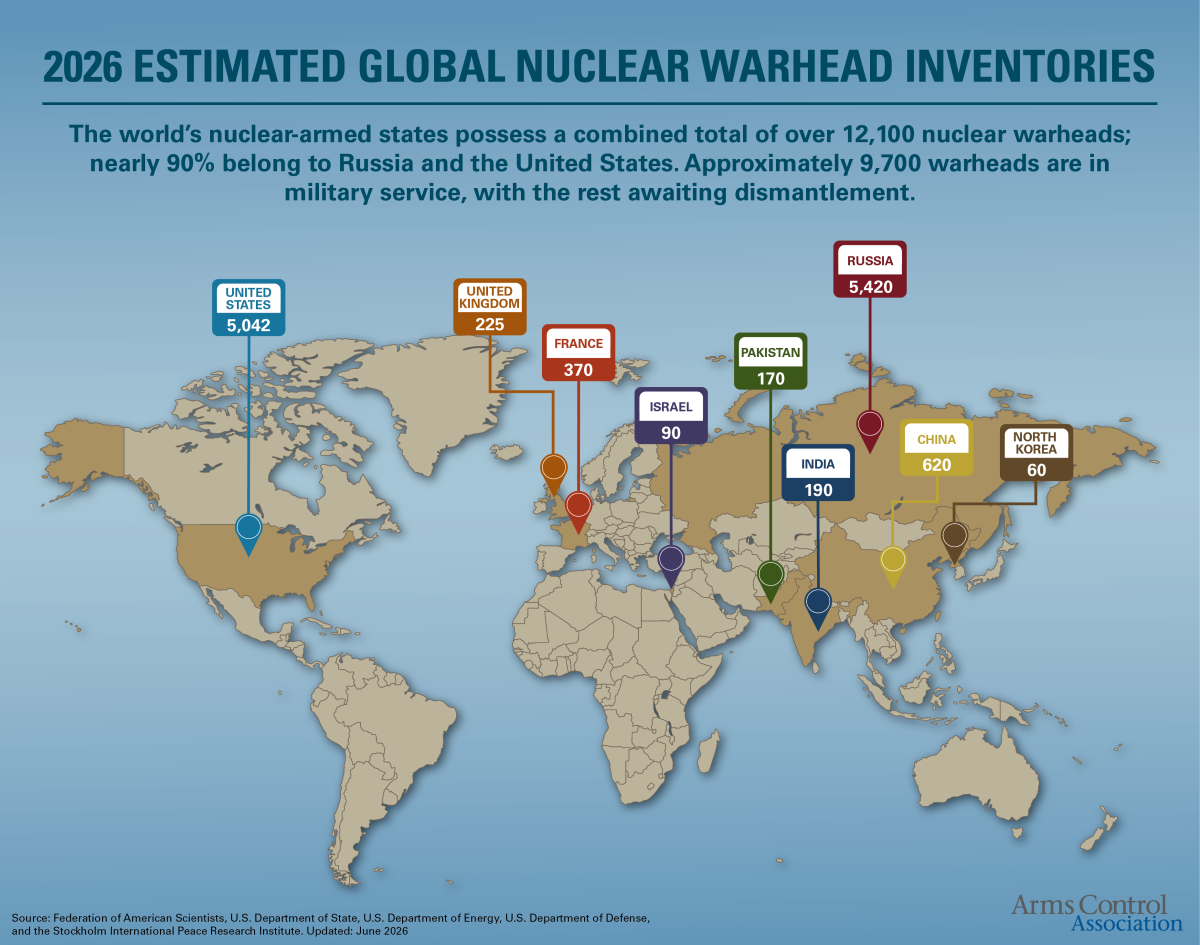
The U.S. has never declared a no-first-use policy. Bills to restrict first use, or to require notice to Congress, have been introduced in recent Congresses, but the president's sole authority remains. Today, that authority rests with President Trump.
The first hours: the human cost
The death toll would depend on where the weapon hit, how powerful it was and which way the wind blew. History shows the scale. A single small bomb killed about 140,000 people in Hiroshima by the end of 1945, according to the city's estimate (Hiroshima Peace Media Center).
The most likely target in this war would be a deeply buried nuclear site, such as the facility Iran is believed to be building under Pickaxe Mountain near Natanz (Al Jazeera). A 2005 National Academies study found that nuclear "bunker busters" cannot dig deep enough to contain the explosion. Radioactive debris would still escape into the air (National Research Council).
The same study shows how wide the range of outcomes is:
Near or in a city: from thousands to more than a million casualties, depending mostly on the weapon's size.
In a lightly populated area: from hundreds to hundreds of thousands, depending on the weapon's size and the wind.
Wind alone: outside cities, it can change the number of fallout deaths by a factor of more than 100.
Survivors would find little help. In March 2025, the Red Cross warned that the effects of nuclear weapons are beyond what any humanitarian organization can handle (ICRC). For a bomb over a capital city, it said, there would be only a handful of specialized burn beds for many thousands of badly burned people. Many of the officials needed to lead a response would be among the dead.
The Middle East: first to pay
The region would absorb the blast, the fallout and the backlash, and some effects could last for decades.
Retaliation against U.S. hosts. Iran has already shown where it would hit back. On February 28, it fired at targets in the UAE, Bahrain, Kuwait, Qatar and Jordan, including the U.S. Navy's Fifth Fleet in Bahrain (NPR). After a nuclear strike, Tehran would have little reason to hold back, and these bases would again be the nearest targets.
Drinking water. More than 60 million people in the Gulf depend on desalinated seawater. Qatar gets about 99% of its drinking water this way, Kuwait and Bahrain over 90%, Oman 86% and Saudi Arabia 70% (Scientific American). Qatar's prime minister has warned that his country could run out of water within three days after a nuclear accident.
Oil. The Strait of Hormuz normally carries about a quarter of the world's seaborne oil. Flows through it fell nearly 30% in the first quarter of 2026 as the war choked shipping (Transport Topics, citing EIA data). A nuclear strike would raise the risk of a longer, total shutdown and of attacks on Gulf oil facilities.
A new arms race. As of this spring, Iran was believed to hold about 440 kilograms of uranium enriched to 60%, close to weapons grade (Arms Control Association). A nuclear attack could convince its leaders that only a bomb of their own would prevent the next one. Saudi Arabia has said it would follow if Iran built nuclear weapons. In September 2025, it also signed a mutual defense pact with nuclear-armed Pakistan, though Pakistan's defense minister said nuclear weapons were not part of the deal (Prothom Alo, citing Reuters).
America: the costs would come home
A nuclear strike abroad would reach Americans through their troops, their safety, their wallets and their politics.
Troops within range. The U.S. usually keeps about 40,000 troops in the Middle East. By late March 2026, that number had passed 50,000 (RBC-Ukraine, citing The New York Times). Many serve at the same Gulf bases Iran has already targeted.
Security at home. In the war's first 100 days, a state intelligence bulletin counted 14 threats and attacks linked to Iran, its proxies, hackers or people it inspired (ABC News). One cyberattack wiped more than 200,000 devices at a medical technology company. A nuclear strike could raise that threat sharply.
Prices. Brent crude briefly hit $126.41 a barrel on April 30, its highest level in four years (CNN via 6abc). U.S. gas averaged $4.10 a gallon on November 5, after the most expensive September on record (AAA). A nuclear strike near the world's main oil route could push both higher again, fast.
Standing abroad. In Pew's 2026 survey, run from February to May, people in 25 of 36 countries viewed China more favorably than the U.S., including Canada and Mexico (The Daily Observer). A Pew researcher linked part of the shift to the war. Becoming the first country since 1945 to use a nuclear weapon would likely push allies further away.
Politics and law. Public support for the war has fallen. A Reuters/Ipsos poll that closed August 24 found 31% of Americans backed U.S. military action against Iran, down from 37% in March, though 69% of Republicans still did (Al-Monitor, citing Reuters). In June, both chambers of Congress passed a resolution directing the president to withdraw U.S. forces from the war, but it carried no legal force (NHPR). Internationally, the World Court found in 1996 that using nuclear weapons would generally violate the laws of war. It left open an extreme case where a state's survival is at stake (ICRC).
The world: breaking a taboo held since 1945
The biggest global effect might be the precedent. No country has used a nuclear weapon in war for 81 years, and breaking that line would make the next use easier to imagine.
Arms control is already fraying. New START, the last treaty capping U.S. and Russian nuclear arsenals, expired on February 5, 2026 (NPR via KAXE). In May, the review conference of the Nuclear Non-Proliferation Treaty ended without an agreed final document for the third time in a row (Adnkronos, citing Jiji Press). A nuclear strike would land on a system that is already weak.
Rivals would gain an argument. At an emergency UN Security Council meeting on February 28, Russia and China condemned the U.S.-Israeli strikes as illegal, while Washington called them lawful self-defense (The Nation Thailand). A nuclear strike would hand Moscow and Beijing a far stronger case against Washington.
The climate risk depends on escalation. A single strike on a remote site would be unlikely to change the global climate. In the major studies, the cooling comes from soot rising from cities set on fire. But a 2022 study in Nature Food found that even a limited India-Pakistan nuclear war could cut world calorie production by 7% within five years (UCAR). A full U.S.-Russia war could kill more than 5 billion people through famine. That is why escalation, more than the first strike, is the deepest fear.
Why it remains unlikely
A U.S. nuclear strike is still very unlikely, and the strongest reasons are on the record.
The president has ruled it out. In April, Trump said the U.S. had already done heavy damage to Iran by conventional means (Arms Control Association). In October, he again rejected nuclear and tactical nuclear weapons (Al Jazeera).
Conventional options exist. The administration has reportedly weighed using the MOAB, the largest U.S. non-nuclear bomb, against targets such as Pickaxe Mountain (Al Jazeera).
The costs are the deterrent. Mass casualties, attacks on U.S. troops, an oil shock and a broken taboo all weigh against giving the order.
Diplomacy is still open. Qatari mediators were in Tehran in early November, though the two sides remain far apart (Just Security).
The war itself remains contested. At the UN, the U.S. called its strikes lawful self-defense to keep Iran from getting a nuclear weapon (The Nation Thailand). Critics, including a majority of Americans in recent polls, say it has already cost too much.
On one point the record is clear. A U.S. president can order a nuclear strike within minutes, so the real safeguard is the choice not to. Since 1945, every president has made that choice.
Sources
Trump Dismisses Using Nuclear Arms Against Iran as Talks Stall — Arms Control Association, May 2026
Trump rules out using a nuclear bomb on Iran: Why that matters — Al Jazeera, October 16, 2026
Early Edition: November 3, 2026 — Just Security
Defense Primer: Command and Control of Nuclear Forces — Congressional Research Service, May 2024
Why don't we know the exact death toll from the bombing? — Hiroshima Peace Media Center, 2018
Effects of Nuclear Earth-Penetrator and Other Weapons, Chapter 9 — National Research Council, 2005
The humanitarian impacts of nuclear weapons are beyond the capacity of any humanitarian organization to address effectively — ICRC and IFRC, March 2025
Gulf countries that host U.S. military bases say Iran has retaliated — NPR, February 28, 2026
War in Iran spotlights the risk to drinking water for millions in the Persian Gulf — Scientific American, 2026
Hormuz Oil Flows Fell Nearly 30% in Q1, EIA Says — Transport Topics (Bloomberg), May 2026
Saudi pact puts Pakistan's nuclear umbrella into Middle East security picture — Prothom Alo (Reuters), September 2025
US ramps up presence in Middle East with 50,000 soldiers — RBC-Ukraine, citing The New York Times, March 30, 2026
Iran and proxies have carried out or threatened 14 attacks since war's start — ABC News, June 11, 2026
Oil briefly touches $126, its highest price in four years — CNN via 6abc, April 30, 2026
Gas prices, 2026 — AAA
China overtakes US in global favourability for first time — The Daily Observer, July 17, 2026
Trump's approval holds at record low as US support for Iran war falls — Al-Monitor (Reuters), August 24, 2026
In symbolic vote, Congress directs Trump to remove forces from Iran war — NHPR (NPR), June 23, 2026
ICRC, Bringing the era of nuclear weapons to an end — ICRC Casebook
For the first time in decades, the U.S. and Russia have no limits on nuclear weapons — NPR via KAXE, February 2026
NPT Review Conference Ends without Final Document — Adnkronos (Jiji Press), May 23, 2026
UN Security Council split as US and Israel defend Iran strikes — The Nation Thailand, March 3, 2026
Nuclear war would cause global famine — UCAR, August 15, 2022